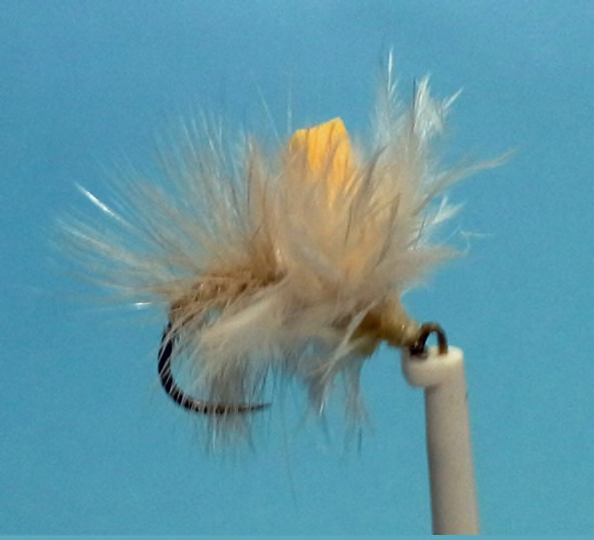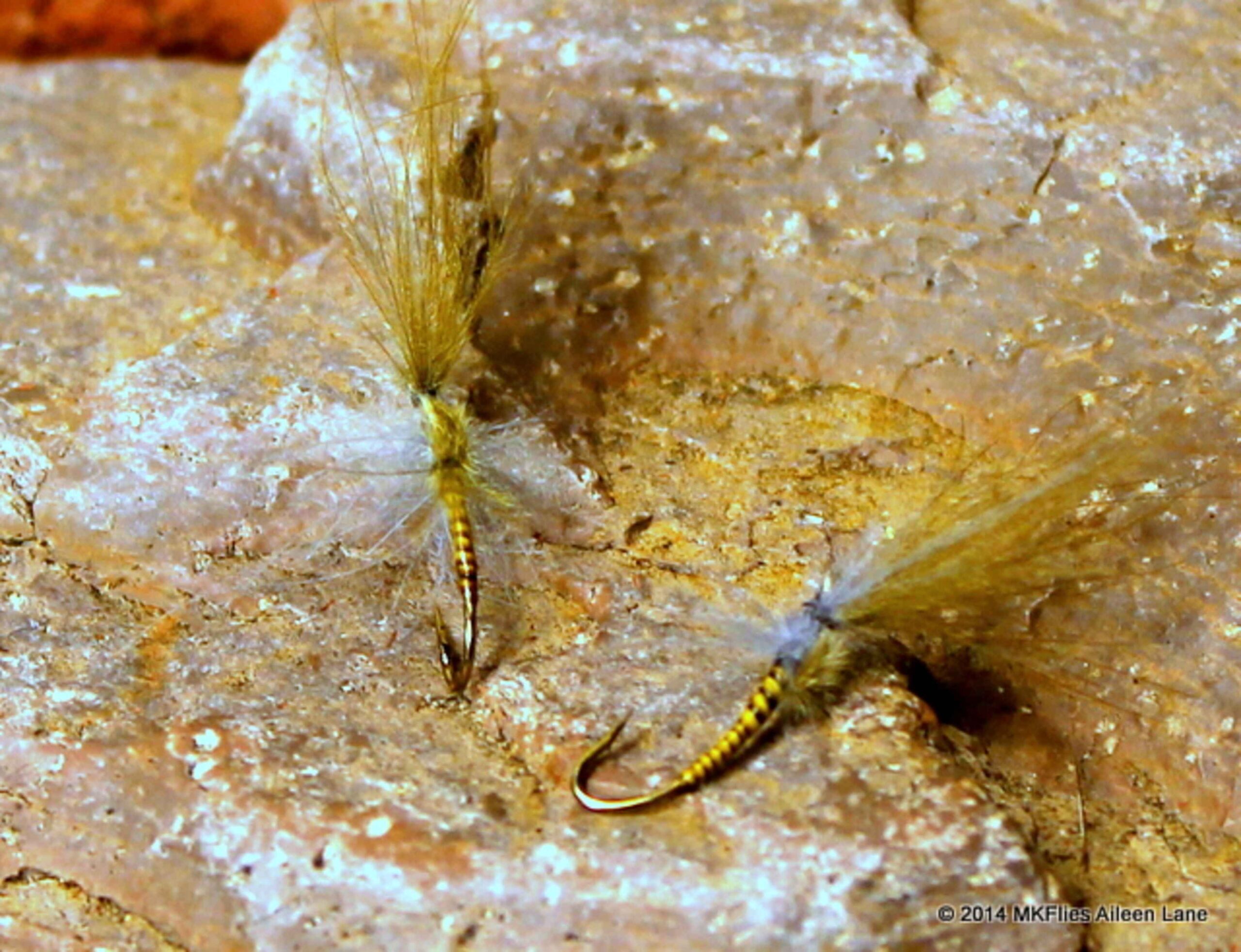

The Shuttlecock buzzer is a great emerger pattern for fishing on the top to rising fish.
Created by Sid Knight, it was designed for use in dams, reservoirs and stillwater fishing. Cast this fly to feed channels and drift on still waters.
The Shuttlecock is tied without hackle and instead relies on its wing of grey cul-de-canard feather to keep it floating.
The wing projects so far forward that the body actually sinks beneath the surface and mimics that of a chironomid midge pupa on the very point of transforming into the adult.
Because it is imitating a relatively small insect, the Shuttlecock is most effective tied on hooks from size 14 down to an 18, and for river use this can be used as low as a 24.
Body colour varies from black, olive and fiery brown to red and orange.
Source: The Fly-tying Bible, pp. 84-85

Source: The Fly-tying Bible
Tying Instructions

- Make smooth, even wraps on the thread.

- Tie in the Polish Quill at the narrow end – making sure the darker part side of the quill is on the bottom side (toward the back of the fly).

- Make even wraps of the Polish Quill, then tie down.

- Apply a thin later of UV Resin, then cure with the light.

- Take one CDC feather. Holding the top, brush down the feathers to straighten. Gather one side of the feathers, and pinch off.

- Tie in the pinched off CDC feathers; repeat on the other side.

- Now, to make the CDC loop dubbing, take the second CDC feather and place one side in a flat clip.

- Carefully cut the feather close to the stem, leaving one side in the clip. Using a second clip, place the other half in and cut that off as well at the stem.

- Using a sharp point, split apart the thread.

- Using one hand to keep the thread open, insert the feathers from the clips – trapping them between the thread.

- If the feathers are not in evenly, you may arrange them carefully with your fingers. Then, twist the thread to form your dubbing loop.

- Wrap the dubbing loop around the thorax.

- Next, pull the CDC bunch forward toward the eye of the hook.

- Whip finish the fly.