
One of the biggest challenges in fly fishing moving water is getting your fly to drift naturally. Even a perfectly presented fly can be rendered ineffective if the current catches your leader or fly line and pulls the fly unnaturally across the water. This is known as drag, and fish are remarkably good at spotting it.
Slack line casts help overcome this problem by deliberately introducing extra line between the rod tip and the fly. Rather than landing everything in a straight line, these casts create curves, loops or piles of slack that give the fly time to drift naturally before the current takes hold.
There are several ways to achieve this, but three particularly useful techniques are the Reach Cast, Wiggle Cast and Pile Cast.
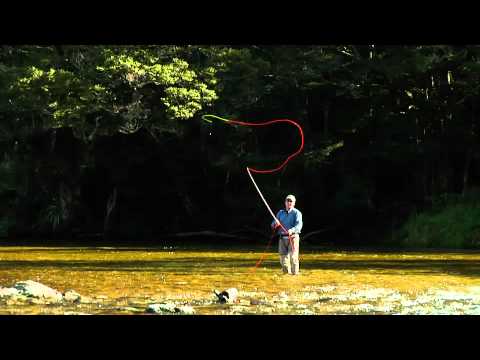
The following instructional videos feature Carl McNeil from Epic Fly Rods’ Casts That Catch Fish series. Each demonstrates a different approach to introducing slack into your presentation.
Reach Cast (Reach Mend)
Of all the slack line casts, this is probably the one you’ll use most often. In fact, if you tend to present your fly side-on and at an angle to the fish (and I suggest you do), you’ll want to use this cast pretty much every time you throw a fly.
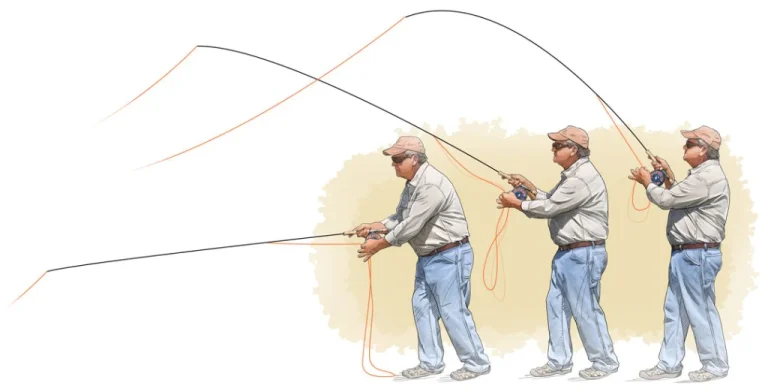
The reach cast allows you to reposition the rod and line immediately after the forward cast, placing a curve in the line before it settles on the water. This gives your fly a head start on its drift, helping to delay drag and achieve a more natural presentation.
It’s a particularly useful technique when casting across or at an angle to the current, where the faster-moving water would otherwise pull your fly line and leader ahead of the fly.

Wiggle Cast
The Wiggle Cast introduces slack along the length of the line, rather than concentrating it in one particular spot. This makes it especially useful when fishing complex currents with multiple variations in speed and direction.
It’s also an excellent choice for accurately presenting your fly first, directly downstream.
Despite being a slack line cast, it has the advantage of offering reasonably good control, even in moderate wind – something the Pile Cast can struggle with.
This is arguably one of the most important and versatile presentation casts to learn. You’ll probably pick up the basic technique fairly quickly, but it takes a little practice to master the timing and produce consistent results.

Pile Cast
What looks like the most basic of the slack line casts is actually quite difficult to execute well. The Pile Cast, also known as the Puddle or Parachute Cast, is designed to land the line in a loose pile rather than a straight line.
By introducing a considerable amount of slack as the line lands, the fly can drift naturally for longer before the current begins to pull on the leader.
It’s particularly useful when fishing directly upstream or when you need to place your fly ahead of the line. However, the amount of slack introduced means there’s less immediate control over the line, making it less suitable in windy conditions.
Getting the right amount of slack, while still maintaining an accurate presentation, takes a bit of practice.

Putting them into practice
What looks like the most basic of the slack line casts is actually quite difficult to execute well. The Pile Cast, also known as the Puddle or Parachute Cast, is designed to land the line in a loose pile rather than a straight line.
By introducing a considerable amount of slack as the line lands, the fly can drift naturally for longer before the current begins to pull on the leader.
It’s particularly useful when fishing directly upstream or when you need to place your fly ahead of the line. However, the amount of slack introduced means there’s less immediate control over the line, making it less suitable in windy conditions.
Getting the right amount of slack, while still maintaining an accurate presentation, takes a bit of practice.