If you have ever finished a cast only to discover a knot in your leader, you are not alone! These frustrating knots, sometimes called wind knots, are a common problem for fly fishers. However, despite the name, they are often caused by a fault in the casting stroke rather than the wind. One of the main culprits is a tailing loop.
Understanding how casting loops form, what causes them to go wrong and how to correct them will help you cast more efficiently, improve your presentation and spend less time untangling your leader.
What is a casting loop?
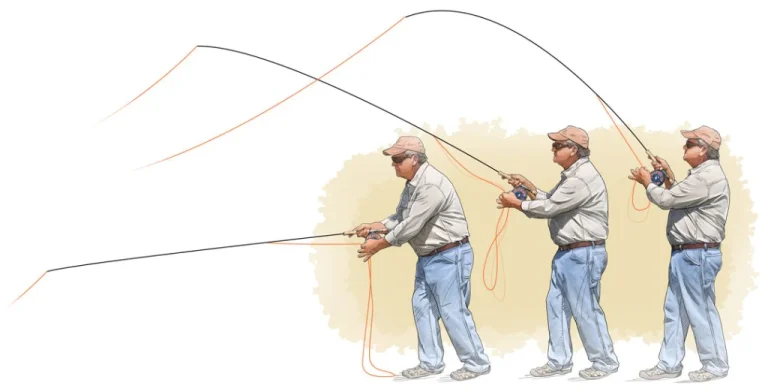
When you cast a fly line, the rod bends under the load of the line and then straightens, transferring energy into the line. As the line travels forward or backward, it forms a loop that unrolls through the air.
A good casting loop is generally narrow enough to travel efficiently but open enough to avoid the fly line, leader and fly becoming tangled. The shape of the loop depends on how the rod tip travels during the casting stroke.
In a well-executed cast, the rod tip follows a controlled path, allowing the line to form a smooth loop. However, if the rod tip dips unexpectedly during the stroke, the line can form a loop that crosses over itself. This is known as a tailing loop.
What causes a tailing loop?
A tailing loop typically occurs when the rod bends too much, too early in the casting stroke. This can happen when too much power is applied at the beginning of the stroke, causing the rod tip to dip before moving forward again.
Instead of travelling along a smooth path, the rod tip follows a concave path, producing a crossover in the fly line. The resulting tangle can transfer down the line and create a knot in the leader.
Tailing loops are particularly common when anglers become excited by a rising fish or try to cast further by applying extra force. Unfortunately, trying harder often makes the problem worse!
Three ways to correct a tailing loop
1. Apply power progressively
Rather than applying a burst of power at the start of the cast, begin smoothly and progressively increase the acceleration towards the end of the stroke.
Think of the casting stroke as starting gently and finishing with a controlled burst of power. This helps prevent the rod from bending excessively too early and encourages the rod tip to follow a smoother path.
2. Imagine flicking water from a paintbrush
This is a useful visualisation technique for learning to apply power at the right moment.
Imagine holding a paintbrush dipped in water. To flick the water off, you would move the brush forward and accelerate towards the end of the movement, rather than forcing it forward from the beginning.
Apply the same idea to your forward cast: start smoothly, then accelerate and stop the rod decisively at the end of the stroke. The aim is to deliver power late and progressively, not to make a sudden, uncontrolled snap with your wrist.
3. Reduce excessive wrist movement
Too much wrist movement can make it difficult to control the rod tip’s path, particularly when you are trying to cast harder or further.
Try using more of your forearm to control the casting stroke, keeping your wrist movements measured and deliberate. Focus on a smooth acceleration and a crisp stop rather than flicking the rod aggressively.
You do not need to eliminate wrist movement altogether. The goal is to develop a controlled stroke that allows the rod to load and unload efficiently.
Practise before you head to the water
The next time you practise casting, pay attention to the timing of your acceleration. If your leader repeatedly develops knots, resist the temptation to apply more power. Instead, try slowing down, building power progressively and finishing the stroke with a controlled stop.
A tailing loop is often a sign that your casting stroke needs a small adjustment rather than a complete overhaul. With practice, you should be able to produce cleaner loops, reduce tangles and present your fly more effectively.

I found this site, sexyloops.com; it has pages of info on fly casting.
Check out their section on flycasting.